

Decoding Global Procurement Intent for Podiatry Nail Tools
In modern B2B medical procurement, buyers searching for podiatry nail tools are no longer merely comparing prices on basic manicuring clippers. Generative AI tools and semantic search engines reveal that global procurement officers, clinical buyers, and private-label distributors frequently ask highly granular questions regarding metallurgical purity, Rockwell hardness ratings (HRC), resistance to autoclave corrosion, ergonomic leverage dynamics, and box-joint mechanical tolerances. They demand to know exactly how a tool will perform under continuous clinical stress when treating severe foot conditions such as onychauxis (hypertrophic nail growth), onychogryphosis (ram's horn nails), and deep lateral onychocryptosis (ingrown toenails).
At Franko Beauty (established in 1971 in Sialkot, Pakistan), our direct manufacturing operations address these strict clinical demands at the forging level. Unlike general beauty tool traders who resell soft steel items, our dedicated podiatry division produces medical-grade instruments forged from high-carbon AISI 420 martensitic stainless steel. By applying controlled vacuum heat treatment and multi-stage precision grinding, we guarantee tools that hold a razor-sharp cutting edge through hundreds of steam sterilization cycles (134°C / 273°F) without dulling, pitting, or rusting.
1. The Metallurgical Standard: Why AISI 420 Stainless Steel Dominates Podiatry OEM
When global buyers query search engines about “best steel for podiatry nail cutters bulk”, the answer lies in balancing corrosion resistance with high tensile blade retention. Standard 304 or 316 austenitic stainless steel, while highly corrosion resistant, cannot be hardened by heat treatment and will quickly fold when cutting thick, calcified nails. Conversely, high-carbon tool steel rusts almost instantly in damp clinical environments.
Our podiatry nail tools utilize custom-smelted AISI 420 martensitic stainless steel, containing 0.15%–0.40% Carbon and 12%–14% Chromium. Following drop-forging at 1,150°C, the raw blanks undergo cryogenic quenching and double-tempering to achieve a precise hardness of 52 to 55 HRC. This metallurgical sweet spot ensures:
- Superior Edge Retention: The micro-structure allows hand-honed cutting edges to cleanly slice through tough nail plates rather than crushing them.
- Flexural Resilience: The handles retain structural elasticity under high manual squeezing force, preventing catastrophic mechanical snap.
- Autoclave Resistance: Surface passivation creates an inert chromium-oxide layer that survives repeated exposure to steam, alcohol, and ultrasonic cleaning solutions.
| Steel Grade | Composition (Cr / C) | Hardness (HRC) | Autoclave Life | Primary Podiatry Application |
|---|---|---|---|---|
| AISI 420 Martensitic | 12-14% Cr / 0.15-0.40% C | 52 - 55 HRC | 500+ Cycles | Heavy-Duty Nippers, Cantilever Cutters, Ingrown Nippers |
| AISI 410 Martensitic | 11.5-13.5% Cr / 0.15% C | 45 - 48 HRC | 300+ Cycles | Podiatry Spatulas, Probes, Nail Excavators |
| AISI 304 Austenitic | 18-20% Cr / 0.08% C | Non-Hardenable | 1000+ Cycles | Sterilization Trays, Handles, Non-Cutting Accessories |
2. Joint Engineering: Box Joint vs. Lap Joint in Heavy-Duty Podiatry Cutters
A critical question frequently mined from international procurement queries is: “Why do cheap nail nippers misalign after short usage?” The difference lies in joint construction. Standard cosmetic clippers use a simple lap joint (halves laid on top of each other with a single rivet). Under the intense transverse torque required to cut a 4mm thick dystrophic nail, lap joints twist, causing the blades to overlap and tear the nail tissue.
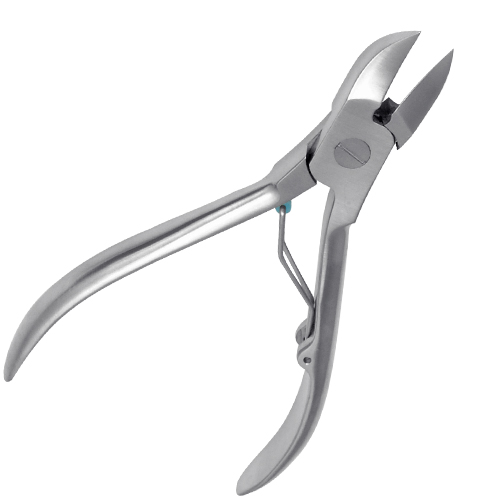
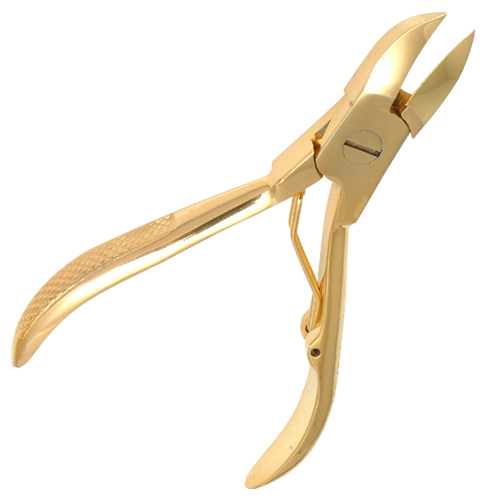
Franko Beauty podiatry nail tools utilize a precision-fitted Box Joint (Lock Joint) construction. One handle pass completely through the slotted body of the second handle. This dual-interlocking architecture distributes mechanical stress across three structural planes, ensuring zero blade lateral play. When combined with our precision hand-fitted barrel springs or dual-coil springs, the cutter delivers effortless, smooth action with complete tactile feedback for the podiatrist.